Leonora Carrington built her own psychic universe rooted in personal myth, Celtic folklore, alchemy, and rebellion. This painting is a vivid expression of her deeply symbolic visual language — wild, dreamlike, and unapologetically her own.
Let’s dive in:

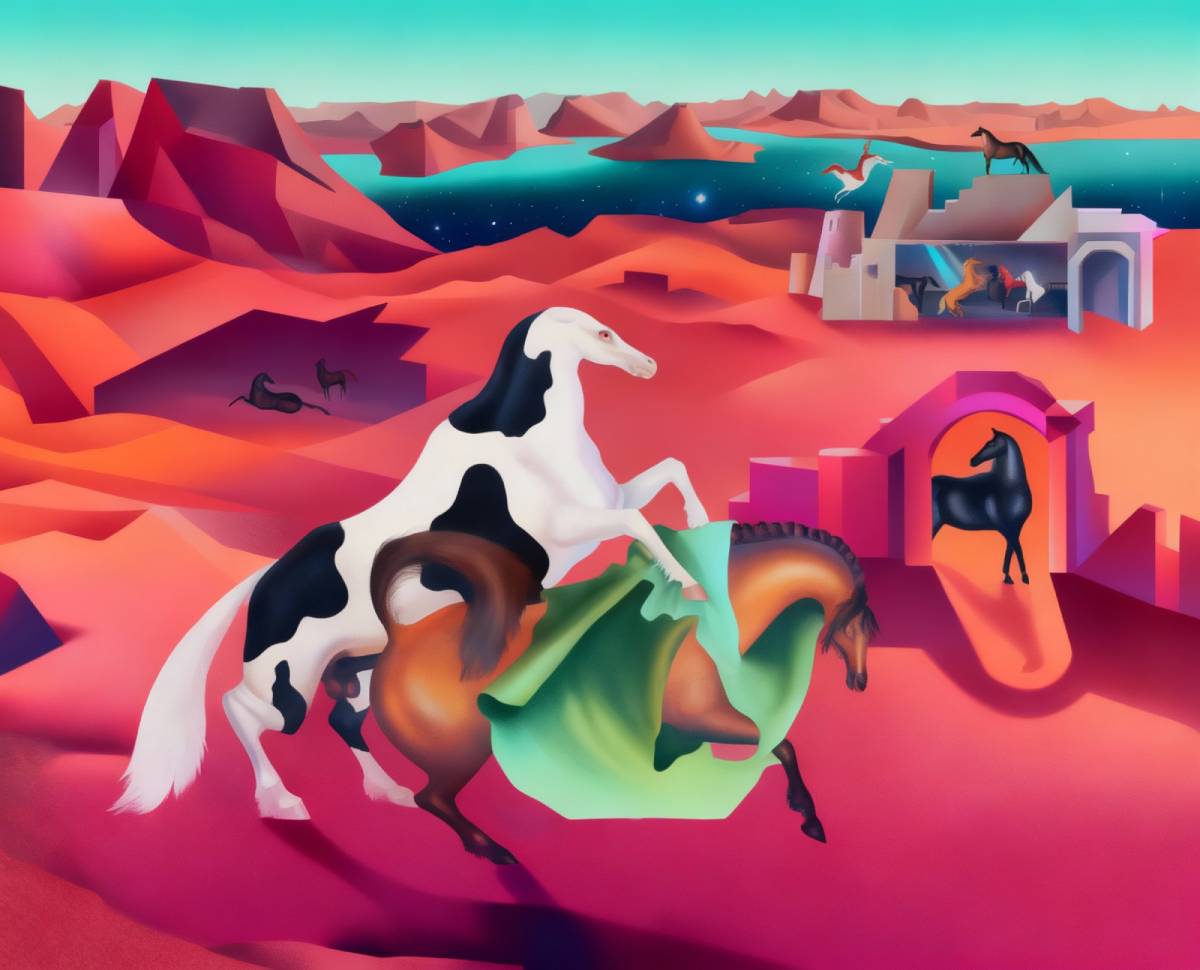
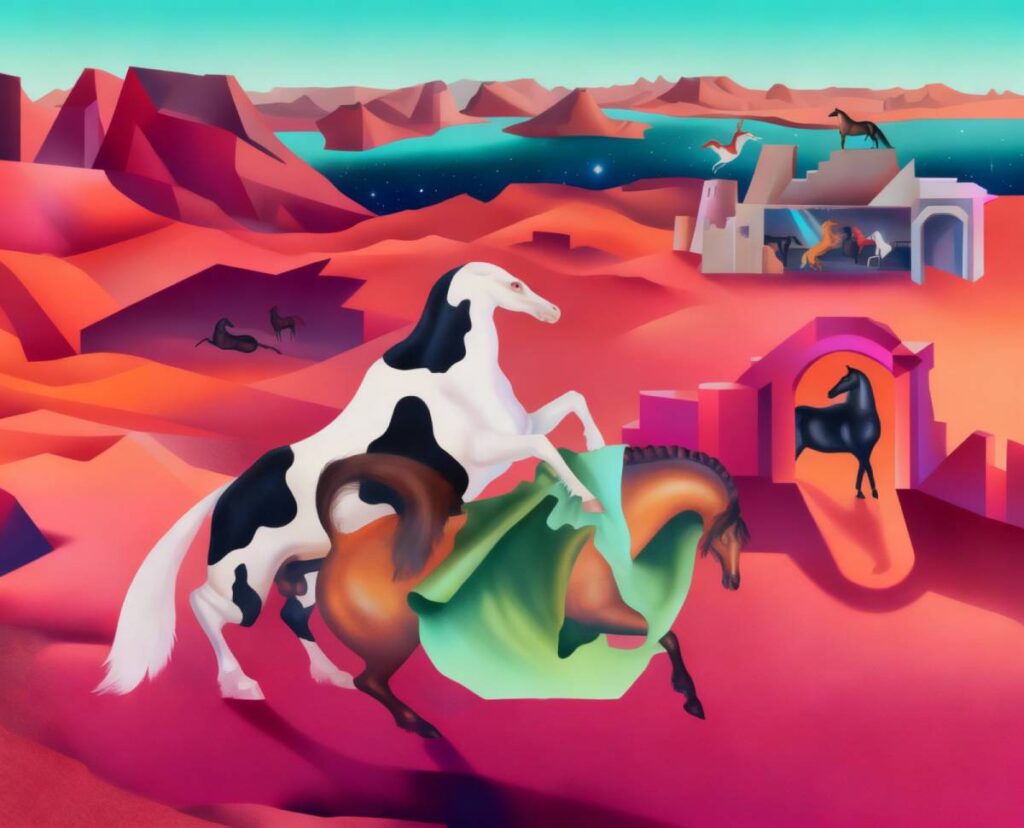
🐎 Central Imagery: The Horses
At the heart of the composition are two rearing horses, engaged in an almost balletic motion:
- One is black-and-white (like a pinto), exaggerated in form, and strangely rigid.
- The other is golden with a green sheet or figure draped over its back — perhaps a shapeshifting woman (a common Carrington motif) or a spirit.
What do they represent?
- Freedom and Transformation: For Carrington, horses were a core symbol of personal liberation, especially from patriarchal and artistic constraints.
- Inner Psyche in Conflict or Harmony: The two horses may represent duality — reason and instinct, conscious and unconscious, or body and spirit — interacting, struggling, or blending.
- Feminine Power: Unlike the traditional role of horses as noble steeds or male-dominated symbols, Carrington’s horses are often wild, feminine, self-willed, and intimately tied to her own identity.
🏞 The Landscape
The terrain is surreal — a desert-like, reddish-pink dreamscape with blue water and mountain peaks in the background.
- It recalls mythic or otherworldly geographies, untethered from real space. Carrington was not painting a place — she was painting a mental or spiritual state.
- The burning or smoking mountains in the back suggest volatility, transformation, and spiritual alchemy.
- The water separating the background from the foreground may symbolize a threshold or unconscious realm.
🏰 Architecture and Shadows
On the right, we see strange ruins or structures — perhaps an ancient city, monastery, or dream palace. Inside and outside these structures are more horses, people, and ambiguous interactions:
- One black horse casts a human-like shadow on the wall — suggesting shapeshifting or hidden identity.
- A standing figure nearby is in shadow, potentially observing or summoning.
Symbolic Interpretations:
- Thresholds of Identity: Walls, arches, and shadows in Carrington’s work often represent passages between states of being, or between visible and invisible selves.
- Surreal Theater: Like a staged dream, these spaces feel suspended between past and future, real and imagined.
🧙♀️ Carrington’s Personal Mythology
Painted in 1941, after Carrington had fled wartime Europe and was recovering from a psychological breakdown, Caballos can be read as a painting of psychic healing and resistance:
- Horses were her alter-egos: powerful, unbroken, untamed.
- The female presence draped in green may represent Carrington herself — not riding the horse, but fused with it.
🎨 Visual Language and Style
- The palette is earthy, fantastical, and symbolic — reds (blood, earth), blues (depth, emotion), and golds (spirit, alchemy).
- The forms are stylized, almost naïve — reflecting dream logic rather than realism.
- The mood is tense and mystical, suspended in a timeless, narrative-less world.
🧩 Final Reading
“Caballos” is a personal myth in motion — a vision of inner worlds where identities shift, creatures transform, and power is reclaimed. Carrington, like Fini, paints not to depict the external world, but to chart the terrain of the self — especially the feminine self freed from convention.
In this painting:
- Horses are not tamed — they are sovereign beings.
- Architecture is not shelter — it is mystery and metaphor.
- The world is not fixed — it is in constant alchemical flux.
It’s a dream from which Carrington never wanted to wake — and one we’re lucky to witness.
Images in this article are inspired by
Leonora Carrington, “Caballos”, 1941. Oil on canvas, 66,5 x 81 cm. La Galleria Nazionale d’Arte Moderna e Contemporanea, Roma, Italy

Pingback: Leonora Carrington: Orplied (1955) - Women In Art