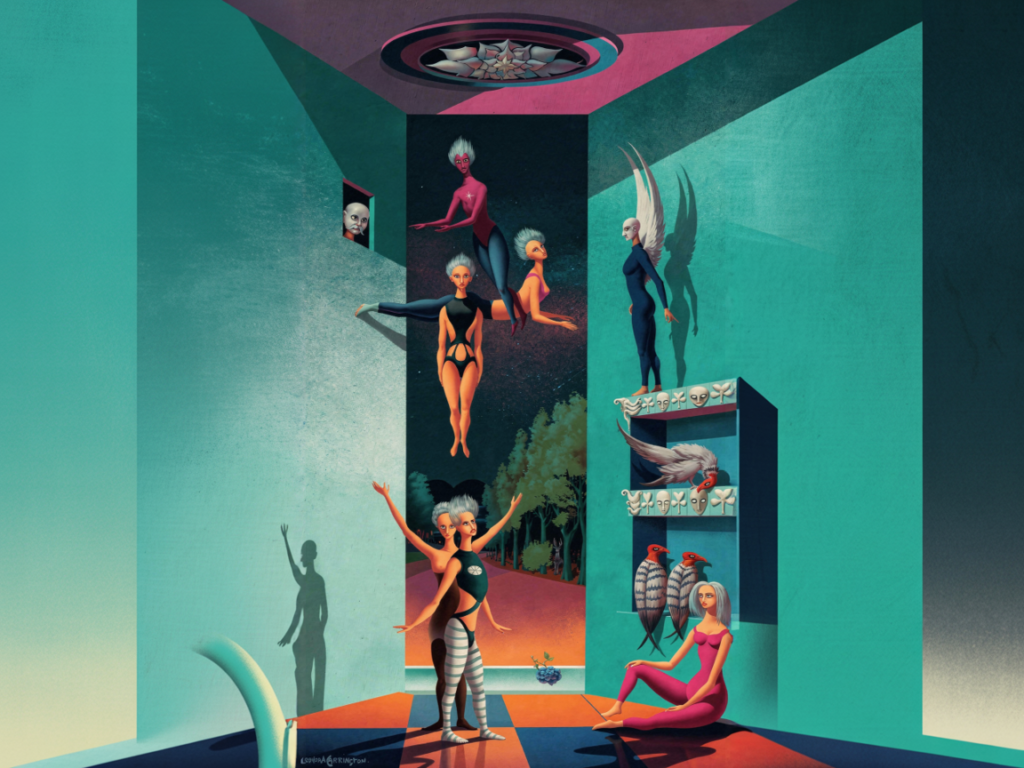
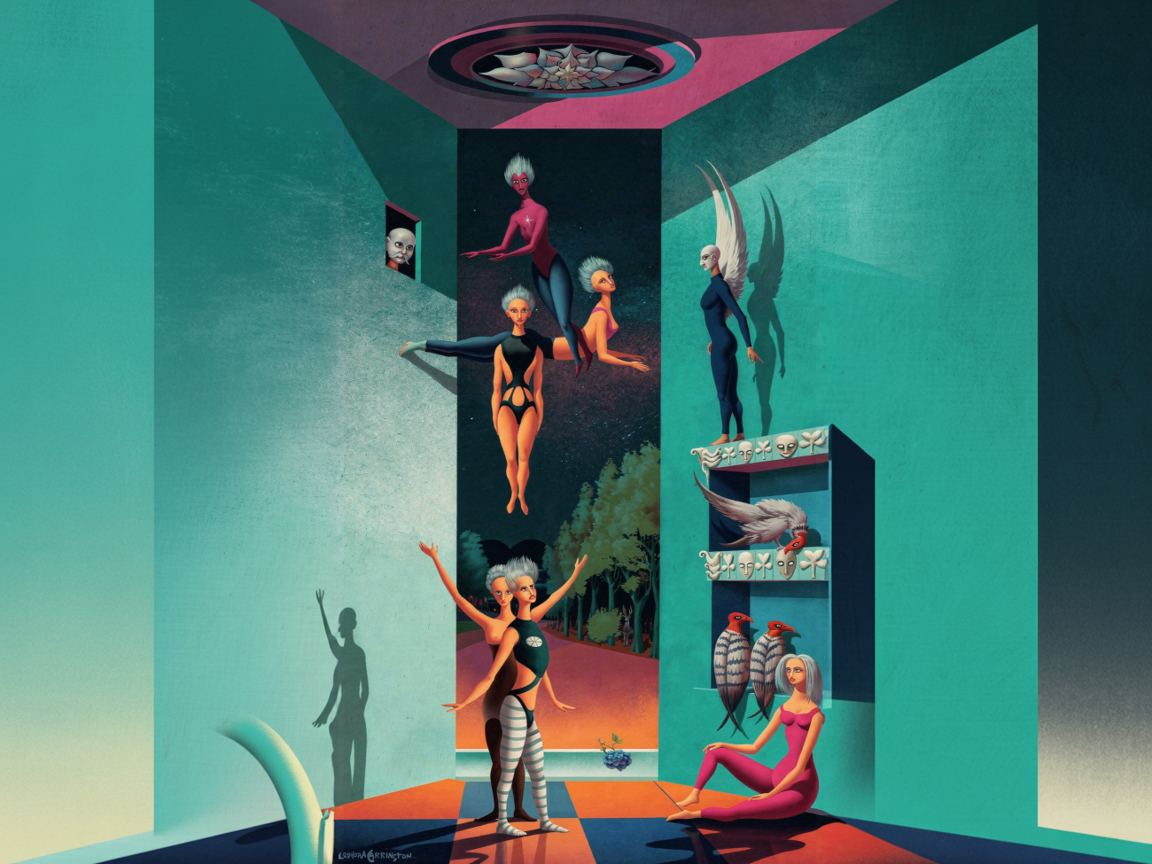
“Levitasium” (1950) by Leonora Carrington is deeply surreal, mysterious, and theatrical composition that invites contemplation rather than explanation. The title itself — Levitasium — is a fictional, alchemical-sounding word, likely invented by Carrington. It suggests something like levity or levitation — perhaps an element of weightlessness, ascension, or metaphysical lightness.
Let’s unpack what’s happening in this remarkable painting.

Leonora Carrington, “Levitasium”, ca. 1950, oil on canvas, 55.2 x 30.1 cm, © Estate of Leonora Carrington, ph. courtesy Palazzo Reale Milano
🧬 1. The Title: “Levitasium”
Carrington frequently used made-up words that sounded scientific, magical, or alchemical. “Levitasium” could evoke:
- Levity / levitation – defying gravity, rising spiritually
- A fictitious element – like a mystical counterpart to the periodic table
- A magical state of being – airy, transcendent, psychically elevated
Thus, the painting might depict a realm or ritual powered by this invented force.
🧝♀️ 2. The Figures: Hybrids and Priestesses
- The characters are female or androgynous, with pale, glowing hair, elongated limbs, and non-human features — traits typical of Carrington’s magical beings.
- The figure in the center wears striped legs and a dark, mask-like garment — evoking a ritual costume.
- Several figures seem to be floating or emerging from the walls — suggesting they exist between dimensions.
- Some hold gestures of invocation, dance, or offering — as if engaged in a ritual or performance.
These beings seem weightless, not quite bound by human physics — as though Levitasium is the metaphysical “air” they inhabit.
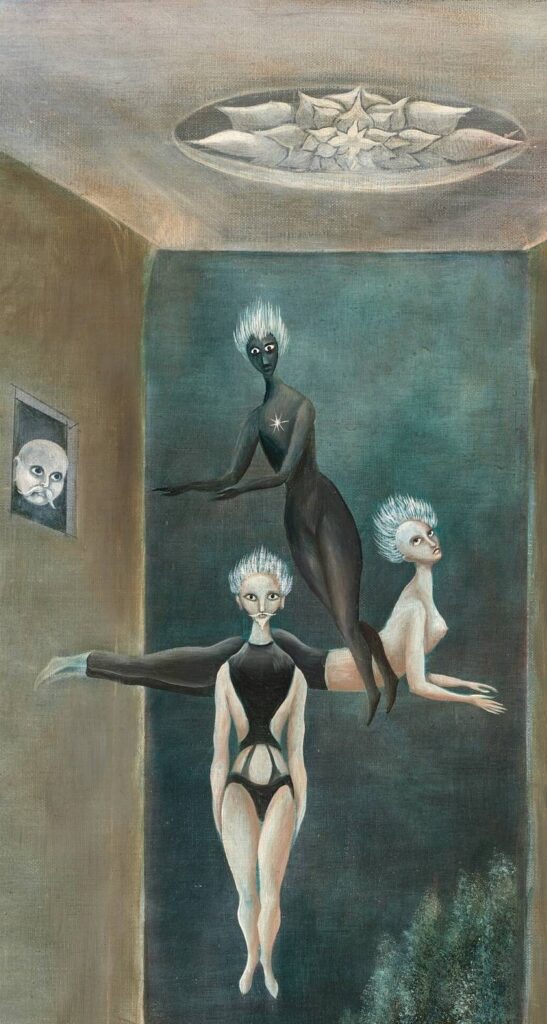
Leonora Carrington, “Levitasium”, ca. 1950, oil on canvas, 55.2 x 30.1 cm, © Estate of Leonora Carrington, ph. courtesy Palazzo Reale Milano
The mysterious head peering in through the hole: What (or Who) Is This Head?
The mysterious head peering in through the hole on the left wall of Levitasium is one of the most intriguing and haunting details in the painting. Let’s examine it more closely:
- It appears to be a disembodied head, hovering in a square opening in the wall, watching the surreal ritual unfolding within the room.
- The face is pale, expressionless, mask-like, with slightly raised eyebrows — as if in calm curiosity, not alarm.
- Its placement and framing make it feel like it’s outside the reality of the painting, yet deeply involved — a voyeur, observer, or intruder from another plane.
🧩 Possible Interpretations
1. The Watcher or Guardian
- In alchemical or esoteric traditions, a ritual or transformation is often witnessed by a guardian or initiator.
- This head could symbolize an initiating presence, watching the levitation rite unfold from outside, perhaps guiding or judging the process.
- But it doesn’t intervene — it simply sees.
2. Carrington Herself
It’s possible this head is a self-insertion — a metaphorical self-portrait of Leonora Carrington as the observer of her own inner visions. Many surrealist women artists used disembodied heads or hidden faces to represent psychic doubling or self-awareness from the outside.
In this case, Carrington could be watching her own dream-ritual from outside time, as if saying:
“This is my subconscious theater — I’ve staged it, but I am not inside it.”
3. The Rational Mind, Shut Out
The head is outside the room, not participating — perhaps representing the rational ego, masculine logic, or outside society, observing but excluded from the mystical feminine rite. It may be a commentary on patriarchy or rationalism — looking in, but unable to grasp or enter the magic.
4. The Surrealist Spectator
Carrington was part of the surrealist movement but always at odds with its male-dominated structures. The head might be a surrealist male observer, peering into a feminine world he cannot control, represent, or even fully understand — Carrington’s way of asserting autonomy.
🪞 The Hole Itself
A hole in the wall is not just a window — it’s a breach. It represents thresholds, voyeurism, and interdimensional sight — a portal between worlds or modes of perception.
The Head as Displaced Consciousness
This head might be:
- A non-intervening initiator
- A spectator-self
- A rational gaze kept at bay
- Or a symbolic outsider, witnessing but not belonging to the sacred logic of the dream.
Its presence amplifies the strangeness of the space. It doesn’t give us answers — it reminds us that even we, the viewers, are being watched as we look.
🧊 3. The Architecture: A Dream Chamber
- The checkered floor suggests a mystical or alchemical chamber — a space of transformation.
- The room is both interior and infinite — one side opens into a lush forest, representing the unconscious, nature, or freedom.
- A hole in the ceiling reveals a floating mass or island — perhaps a symbolic sky or spirit realm.
- The walls display heads, faces, birds, and hybrid forms, like frescoes of an alternate cosmology.
This space is part ritual chamber, part psychic theater.

Leonora Carrington, “Levitasium”, ca. 1950, oil on canvas, 55.2 x 30.1 cm, © Estate of Leonora Carrington, ph. courtesy Palazzo Reale Milano
🐦 4. The Birds and Symbols
Three striped birds with red heads perch on the right — part-real, part-symbolic. In Carrington’s lexicon, birds often represent:
- Spiritual messengers
- Transcendence or transformation
- Hybrid knowledge (animal + divine)
- The blue rose on the floor beneath the central figure may symbolize:
- Mystical love
- Alchemy (in some esoteric systems, the blue rose represents impossible or hidden knowledge)
⚖️ 5. Themes at Work
🔮 Ritual and Feminine Transformation
The figures seem to perform or embody a rite — not for others, but for themselves. Carrington often painted scenes of:
- Feminine awakening
- Spiritual metamorphosis
- Sacred play outside patriarchal structures
This may be a ritual of levitation, a metaphor for elevating consciousness or breaking earthly limitations.

Leonora Carrington, “Levitasium”, ca. 1950, oil on canvas, 55.2 x 30.1 cm, © Estate of Leonora Carrington, ph. courtesy Palazzo Reale Milano
🌌 Space Between Worlds
- The painting exists between solid and fluid, body and spirit, room and forest, performance and vision.
- The figures, suspended between material and immaterial, hint at a metaphysical science of dreams.
Conclusion: What Is “Levitasium”?
It’s not a place or object — it’s a state of being:
- A psychic space where transformation occurs without violence.
- A ritual theater where feminine entities invent new laws of physics, emotion, and selfhood.
- A celebration of the weightless, the fluid, the in-between — the rejection of heaviness and control in favor of freedom, magic, and inner flight.
Carrington’s Levitasium is a visual spell — a declaration that in this world, logic bends, and beings rise by force of mystery, not gravity.