

Orplied is one of Leonora Carrington‘s most densely layered, dreamlike, and esoteric compositions. It’s a vast mythopoeic landscape, almost like a map of a dream world or initiation journey. Carrington’s paintings often function like visual alchemical texts — they are not meant to be read literally but to be entered, meditated on, and slowly unlocked.
Let’s explore what’s happening in Orplied:

🔮 1. The Landscape: A Surreal Ecosystem of Transformation
The painting is set in a lush, mysterious environment that blends jungle, mountain, water, and mist — yet it’s not chaotic. It feels orchestrated, as if every tree, rock, and misty path is part of a ritual space.
- Left side: Bursting with organic life — waterfalls, birds, spiraling energy, lush trees.
- Center: The main action — tiny figures in procession, a white horse, and mystical gatherings.
- Right side: The environment becomes more ethereal, with ghostly trees, a floating crescent moon, and semi-transparent beings.
- Bottom right globe-like dome: Appears like an observatory, temple, or otherworldly portal — a sphere within a sphere.
This terrain isn’t realistic — it’s symbolic. Carrington’s landscapes often represent spiritual or psychological states, and here we may be witnessing multiple layers of consciousness — from earthly ritual to cosmic mystery.
🧝♀️ 2. The Figures: Initiation and Feminine Ceremony
In the center are tiny, detailed figures — mostly women, dressed in flowing robes, gathered in ritualistic gestures. Carrington often painted groups of women as:
- Alchemists
- Priestesses
- Travelers through psychic or magical space
We see:
- A white horse, often a symbol of spirit, transformation, or feminine power
- Processions or gatherings, suggesting a ceremony, initiation, or magical rite
- Figures navigating paths, cliffs, and boats, indicating a journey — perhaps through death, knowledge, or the unconscious
This is not narrative in a linear sense — it’s ritual space frozen in time.
🌙 3. Light, Color, and Duality
- The left side is fiery and golden — active, earthy, filled with plants and motion.
- The right is lunar and silvery — reflective, otherworldly, and quiet. A crescent moon hovers as a sign of the divine feminine, cycles, and hidden knowledge.
- The transition between the two halves may represent the passage from material to spiritual, or from life to dream, body to soul.
🧬 4. The Globe-Like Dome (Bottom Right)

This structure — a translucent orb resting on pillars — feels like a lab, portal, or alchemical vessel. It reflects or contains a miniature version of the world above, hinting at:
- Hermetic philosophy: “As above, so below”
- A microscopic view of transformation
- A space outside time, like a cosmic observatory or inner sanctum
It adds to the sense that this world is being observed or remembered from another dimension.
🧭 5. The Title: “Orplied”
The meaning of Orplied is ambiguous — Carrington often used invented words as titles. It may be a poetic construction:
- “Or” from Latin aurum, meaning gold (alchemical perfection)
- “plied”, as in to weave or bend, suggesting motion, weaving of worlds, or multiplicity
So, Orplied might hint at a golden journey, an act of weaving realities, or a layered transformation.
🧠 Overall Interpretation
“Orplied” is a mythic, feminine vision of initiation and metamorphosis.
It is:
- A ritual map of spiritual passage — perhaps death, rebirth, or mystical ascent
- A celebration of feminine wisdom and ceremony
- A cosmic forest of alchemy, magic, and fluid identity
Carrington doesn’t paint answers — she paints portals. Orplied invites you to enter the painting, walk the winding paths, become the figure in the procession, and remember the myth you didn’t know you’d forgotten.
If Leonor Fini paints mythic women becoming themselves, Carrington paints whole worlds that reimagine existence itself — and Orplied is one of her most stunning examples.

The central procession in Leonora Carrington’s “Orplied” (1955) is visually small, but symbolically monumental.
Let’s break down this scene in context of Carrington’s personal mythology, alchemy, and feminist surrealism.
🎭 What We See:
- A group of robed figures, mostly in soft greens, pinks, and blues, arranged in a ceremonial arc.
- At the center, a larger, silvery figure carrying or elevating a pale, almost luminous woman.
- Many of the figures have horns, hats, or plant-like protrusions — typical of Carrington’s anthropomorphic, hybrid beings.
- To the right, we see what appears to be a priestess with a spiky sun-like head, accompanied by another ethereal figure.
🔍 What Might It Mean?
🔮 1. A Ritual of Initiation or Rebirth
Carrington often depicted initiation rites — particularly those involving female transformation. This central act of carrying or elevating a figure resembles:
- A magical or alchemical elevation, where the initiate (possibly unconscious or in trance) is being led or lifted toward a new state of being.
- It may symbolize death of an old self and rebirth into new knowledge or identity — a spiritual or psychic metamorphosis.
In this case, the carried figure is not passive — she is central, sacred, and honored.
🧬 2. The Alchemical “Coniunctio” or Sacred Union
In alchemy, the coniunctio (or mystical union) is a key moment when opposing forces — male and female, body and spirit, conscious and unconscious — fuse to produce transformation.
- The figure with the scepter-like staff and orb might represent an alchemist or shaman, facilitating this sacred merging.
- The carried woman might be the “prima materia” — the raw spiritual substance from which transformation arises.
🧝♀️ 3. Feminine Ceremony and Ancestral Lineage
Carrington believed in matriarchal spirituality — a world of wisdom passed among women outside of patriarchal systems.
- The surrounding robed women may be initiates or priestesses, forming a circle of transmission.
- This moment might echo a mythic coronation, healing rite, or visionary elevation — where the woman is not rescued, but transformed and claimed by a sacred tradition.
🌱 4. Otherworldly Passage
Because Orplied as a whole seems to depict a journey through psychic realms, this moment might be a crossing between worlds — the woman being carried into:
- The dream realm
- The spirit world
- Her own subconscious
This aligns with Carrington’s belief in shapeshifting identity and the permeability of spiritual boundaries.
✨ Overall Reading of This Section
This scene is likely the ritual center of the painting — a visual key to the whole dreamscape. It’s a ceremony of transformation, where the feminine self is carried, perhaps by ancestral or mythic forces, toward awakening, rebirth, or psychic integration.
It’s not a rescue.
It’s not a sacrifice.
It’s an elevation.
Leonora Carrington replaces patriarchal myths of damsels or victims with visions of self-initiation, mystery, and feminine power — and this passage captures that spirit perfectly.
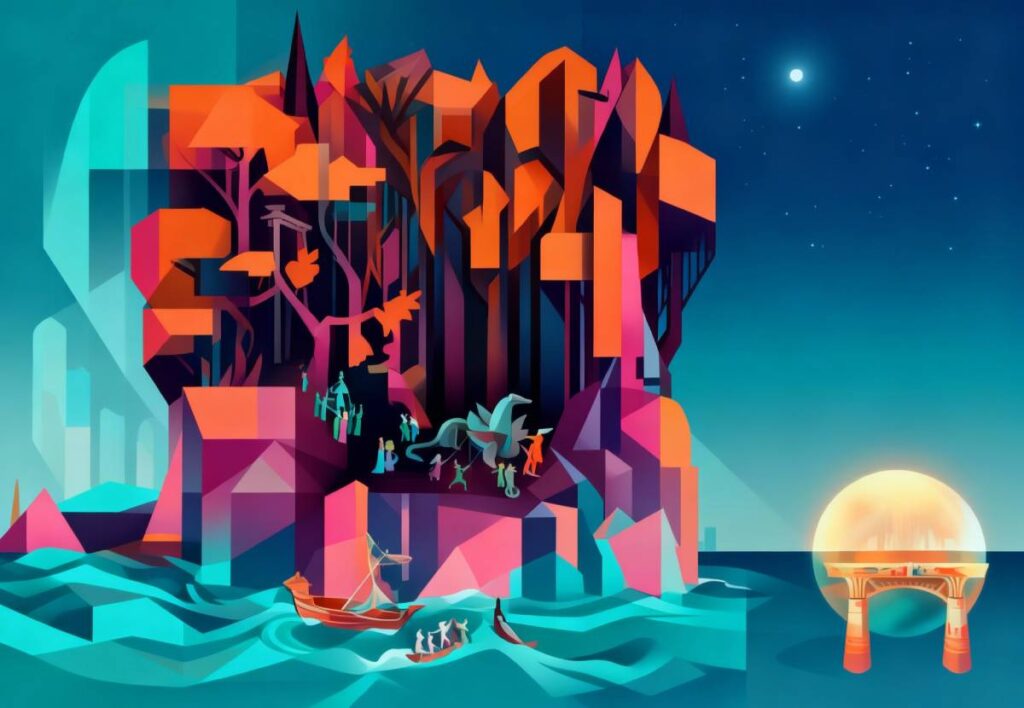
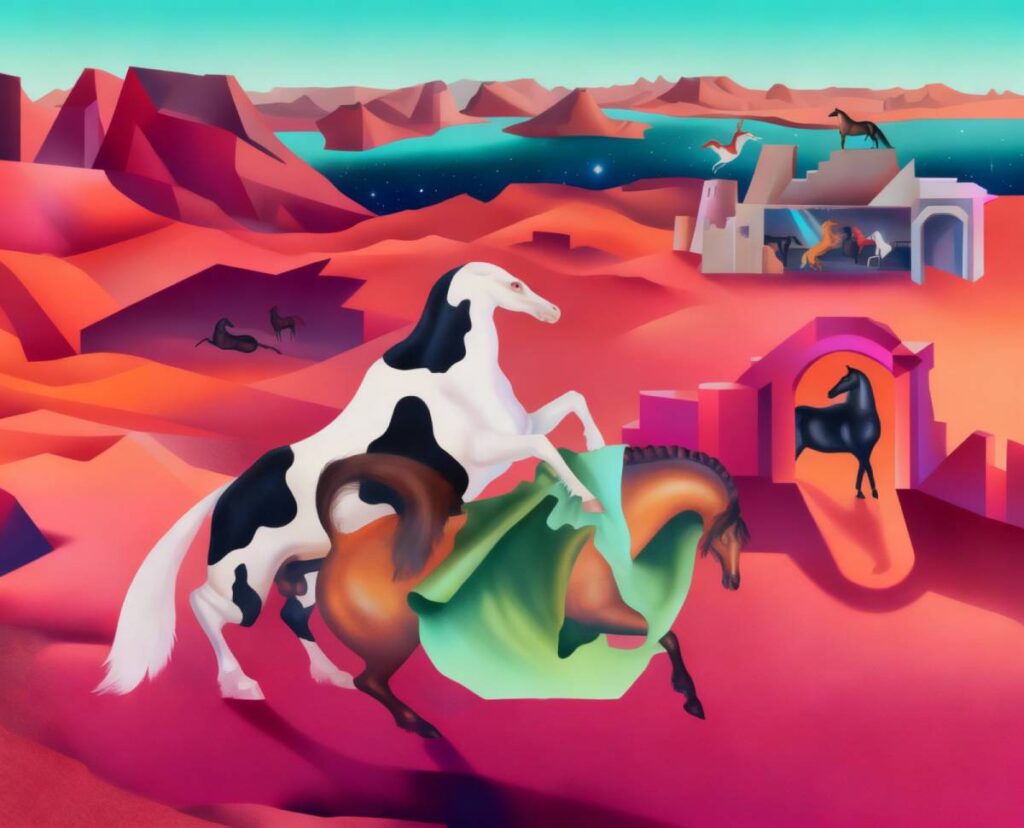
Images in this article are inspired by
Leonora Carrington, “Orplied”, 1955, oil on canvas, 90 x 131 cm, Colección Banco Nacional De México © Estate of Leonora Carrington, by SIAE 2025, ph. courtesy Palazzo Reale Milano

Pingback: Leonora Carrington: Caballos (1941) - Women In Art