✅ What We See
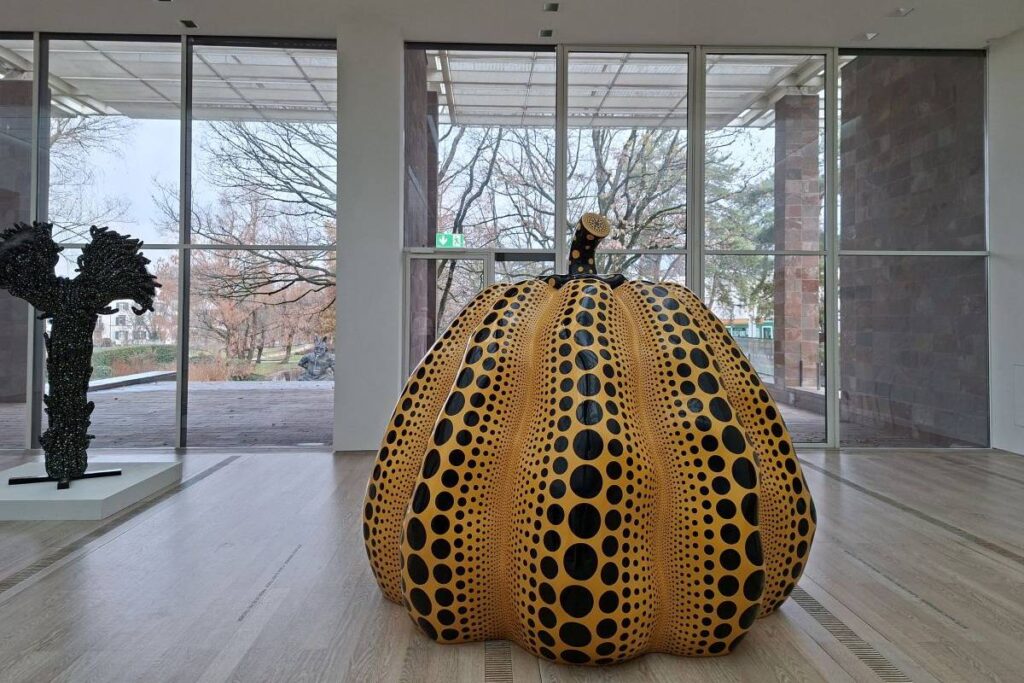
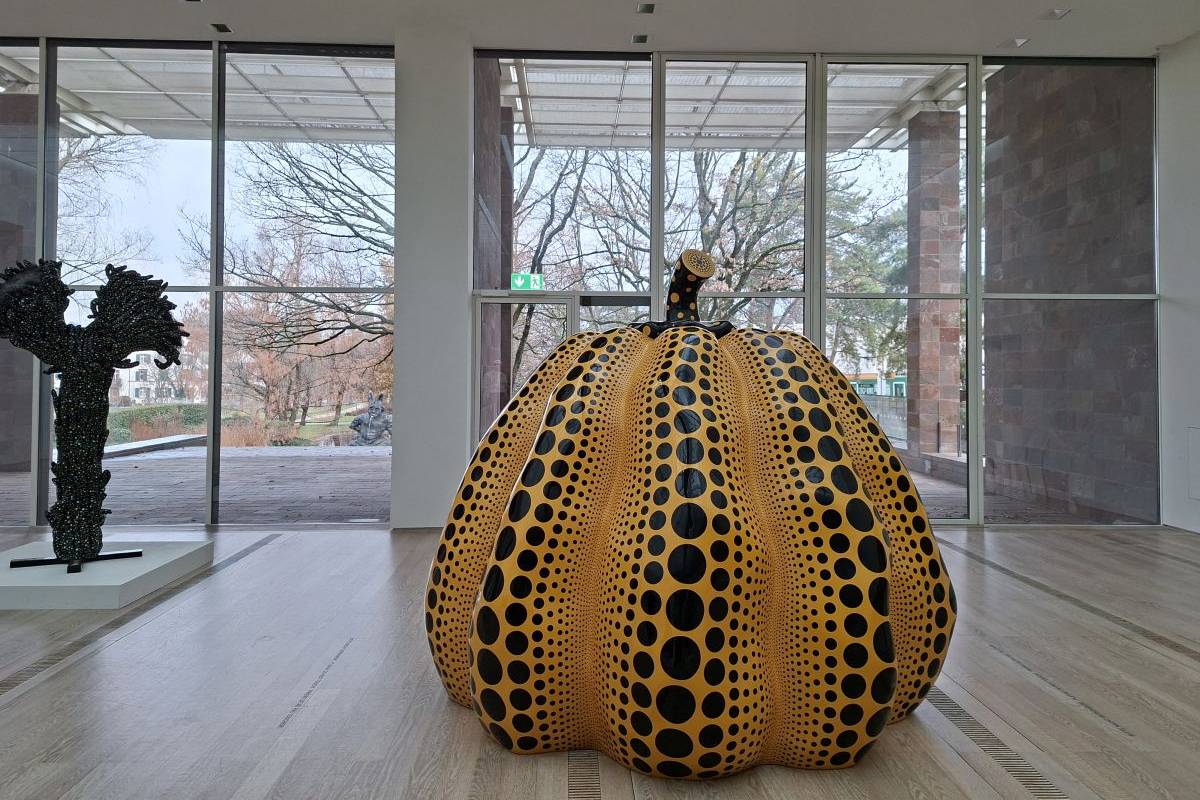
- A large, bulbous yellow pumpkin covered in black polka dots, arranged in radiating patterns.
- Smooth, undulating forms, almost cartoonish yet monumental.
🧠 What It Means: The Pumpkin as a Kusama Icon
1. Personal Symbolism
For Kusama, pumpkins are not just aesthetic — they are deeply autobiographical:
“I love pumpkins. As my spiritual home since childhood, and with their infinite spiritual balance, pumpkins bring me poetic peace and eternal comfort.” — Yayoi Kusama
- She first encountered pumpkins as a child in rural Japan.
- They became symbols of comfort, modesty, and groundedness in contrast to the chaos of her hallucinations and traumas.
- During World War II, pumpkins were also a source of sustenance — a simple, resilient life form.
2. Mental Health and Repetition
Kusama has long lived with obsessive-compulsive hallucinations and voluntarily resides in a psychiatric hospital in Tokyo. Her art is both a coping mechanism and an act of self-erasure.
- The repeated polka dots are a form of infinity and obliteration — they dissolve the self into a larger cosmos.
- The pumpkin, while bold, becomes a vessel for this repetition — a soft, organic form covered in obsessive pattern.
3. A Bridge Between Nature and Infinity
- The organic shape of the pumpkin contrasts with the mathematical regularity of the dots — blending nature with cosmic abstraction.
- It becomes a kind of portal, both grounding and otherworldly.
4. Pop Art, Minimalism, and Feminism
Kusama’s pumpkins also speak to broader art movements:
- Their bright colors and bold shapes recall Pop Art, though Kusama predates Warhol.
- Their seriality and form touch on Minimalism, though hers is more sensuous.
- And as a woman navigating the male-dominated art world of the mid-20th century, Kusama turned to deeply feminine, non-aggressive, eccentric symbols — the pumpkin is soft, curvy, joyful, and totally her own.
5. Themes embodied by the Pumpkin
A. Comfort & healing
Unlike her phallic forms or infinity rooms, pumpkins carry a softer emotional tone:
- safety
- nostalgia
- innocence
They show Kusama’s desire not just to confront fear, but also to create joy.
B. Playfulness & accessibility
Pumpkins became the bridge that brought Kusama to a broader public:
- Families love them
- They photograph beautifully
- They’re whimsical without losing depth
C. The universe in a simple object
The pumpkin is transformed into:
- a microcosm (dots as atoms)
- a macrocosm (dots as stars)
Kusama says pumpkins have a “spiritual balance.”
It’s a symbol of the infinite inside the ordinary.
🌟 Why It Matters
Kusama’s pumpkins are contemporary icons — instantly recognizable, universally lovable, but layered with trauma, resilience, joy, and spiritual longing. They sit at the crossroads of:
- Childhood memory
- Mental health expression
- Pattern as meditation
- The joy of color and repetition
What looks like a fun, oversized squash is, in fact, a lifelong companion, a cosmic symbol, and a deeply private spiritual tool.
⭐ Who is Yayoi Kusama?
Yayoi Kusama is one of the most influential contemporary artists in the world, famous for her polka dots, infinity rooms, and immersive installations.
A Japanese avant-garde artist (born 1929) whose work spans painting, sculpture, installation, performance art, and fashion. She’s often called the “queen of polka dots.”
🎨 Her most iconic themes & motifs
- Polka dots (“infinity nets”), symbolizing endlessness
- Pumpkins, representing comfort and childhood memories
- Infinity Mirror Rooms, immersive light-filled installations
- Organic, psychedelic forms, often repeating obsessively
💡 What makes her art unique?
Kusama’s work is both visually powerful and deeply personal. She has spoken openly about how her art reflects her mental health struggles, hallucinations, and desire to dissolve the boundary between self and universe through repetition and infinity.
🎨 1. Obsession as Artistic Method
Kusama’s art is fundamentally about repetition — dots, nets, organic shapes, mirrors.
This repetition is not decorative; it is a psychological process. Kusama has spoken about experiencing hallucinations since childhood: fields of dots or nets covering everything in sight. Her art reenacts that sensation, turning an internal mental state into a physical environment.
Key elements:
- Serial motifs (dots, nets, phallic forms)
- Repetitive labor — thousands of hand-painted dots
- Monumental accumulation
Her “Infinity Net” paintings are a perfect example: vast canvases filled with thousands of tiny loops, almost meditative but also compulsive.
🌌 2. Infinity & Self-Obliteration
One of Kusama’s deepest themes is the desire to lose oneself in the cosmos — to dissolve the ego. She often says she wants to become part of “the infinity of the universe.”
Her Infinity Mirror Rooms use mirrors and lights to create:
- endless space
- repeated reflections
- a sense of both wonder and disorientation
These installations merge viewer and environment, fulfilling her idea of “self-obliteration.”
🍄 3. Organic, Bodily Forms
Kusama’s early New York period involved soft-sculpture installations filled with phallic shapes, later evolving into pumpkins and amorphous biomorphic forms.
These forms suggest:
- sexuality
- vulnerability
- humor and absurdity
- the human body and nature merging
🎨 4. Polka Dots as a Universe
Her iconic dots symbolize:
- atoms / particles
- planets and cosmic elements
- multiplicity
- obliteration of individuality
She once said:
“Our earth is only one polka dot among a million stars in the cosmos.”
The dot becomes a universal structure — small and infinite at once.
🧪 5. Avant-Garde Performance & Fashion
In the 1960s, Kusama staged provocative performance “happenings” in New York, painting dots on nude bodies, blending:
- art
- activism
- fashion
- psychedelic counterculture
Her work anticipated feminist art, body art, and immersive installation long before these became mainstream.
🌀 6. A Balance of Childlike Playfulness and Existential Depth
Her art can appear playful — bright colors, pumpkins, fun environments — but underneath lies:
- trauma
- hallucinations
- existential fear
- a relentless search for meaning
This tension is what makes her work so resonant.
✨ In short, Kusama’s style is:
- obsessive (repetition as compulsion and meditation)
- cosmic (infinity, self-obliteration)
- organic (bodily shapes, nature motifs)
- immersive (entire environments, not just objects)
- polka-dot structured (as a metaphor for the universe)
- emotionally dual — both playful and psychologically intense